
The Flashpoint: Documents Behind the Dispute
Board Book
The March 12 Board Book is the most important document in understanding how the divide between Antioch University’s leaders and Coalition President John Comerford developed. Rather than rely on competing descriptions of it, Antioch leaders invite journalists to read the relevant pages.
The report was authored and edited by members of Antioch’s leadership team. It was prepared as a direct response from the AU Board’s Finance Committee. That committee asked the new leadership team to use the available data to analyze the financial and operational position of AU, the CCG’s sole academic division.
The posted sections of the Board Book provide the emerging analysis of the Coalition’s governance structure, the economics of programs transferred from Otterbein, leadership costs, and the proposed rollout of shared services.
A few places for journalists and researchers to review include the following. NOTE: The pages are based on the PDF viewer’s “page count.”
- Page 4: The authors affirm that they want the Coalition to succeed. They say the data include favorable and unfavorable findings and that transparent financial analysis strengthens the partnership.
- Pages 9–12: The report examines the transferred programs’ revenue trends, instructional costs, and use of investment funds. These are the underlying numbers behind the questions Antioch’s leaders brought to the Board.
- Pages 17–19: The report identifies missing elements of the proposed shared-services operating model and sets out a specific alternative sequence for developing it. After noting that President Comerford chose another path, it says: “We are following that direction.”
- Page 21: The conclusion explains both the scope and limits of the work. The authors say the newly assembled data will need refinement; they do not present it as beyond question.
Because this report became a flashpoint in the dispute, its language matters.
Readers can see for themselves that Antioch’s leaders raised questions, showed their work, acknowledged uncertainty, and proposed a way forward. The analysis was presented as a step towards joint problem-solving. Nonetheless, it was this very report that was characterized by CCG leaders as being disloyal, biased, and manipulative. The CCG president referred to the information it contained as a ‘full attack on the CCG.'
READ THE BOARD BOOK HERE
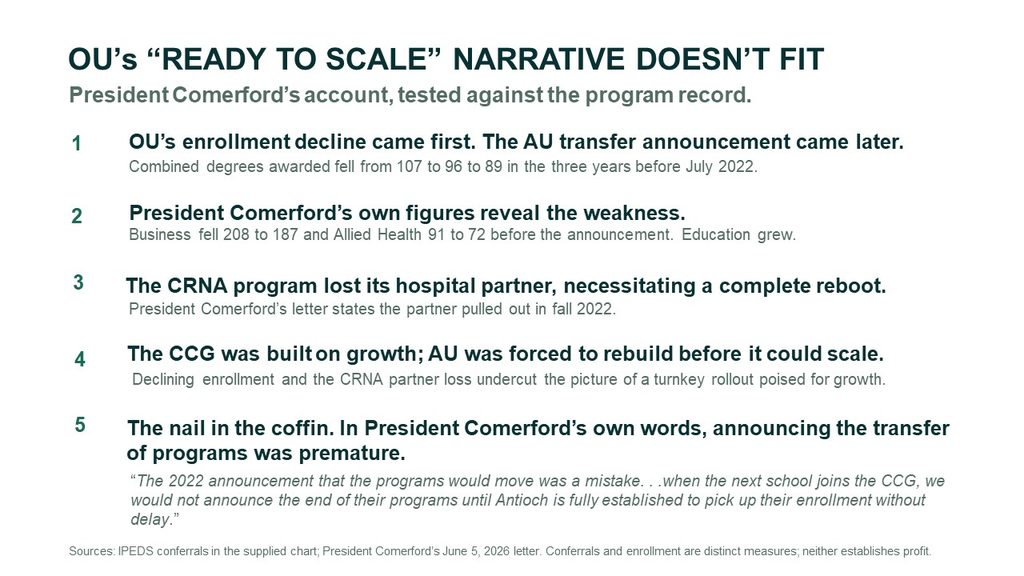
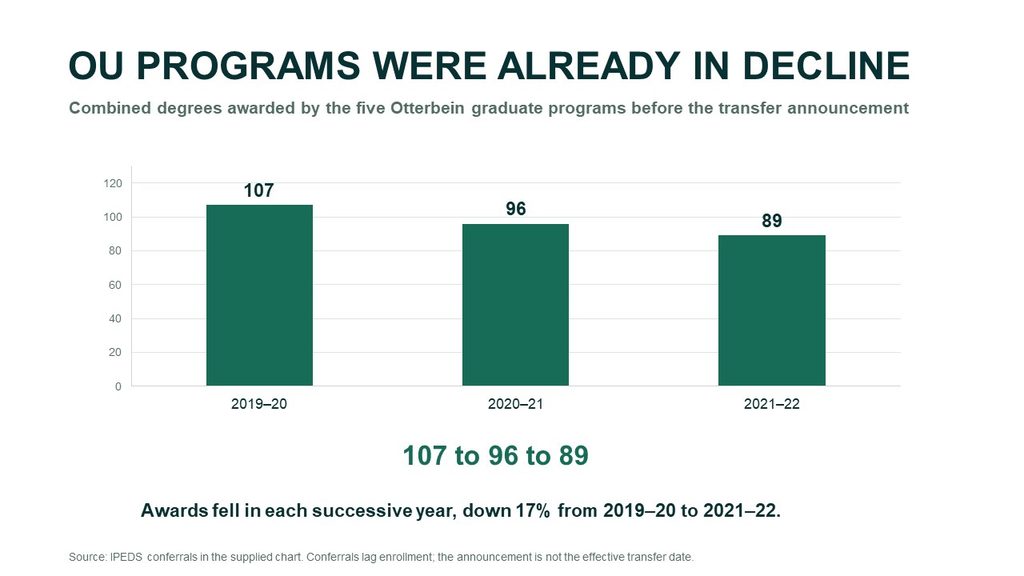
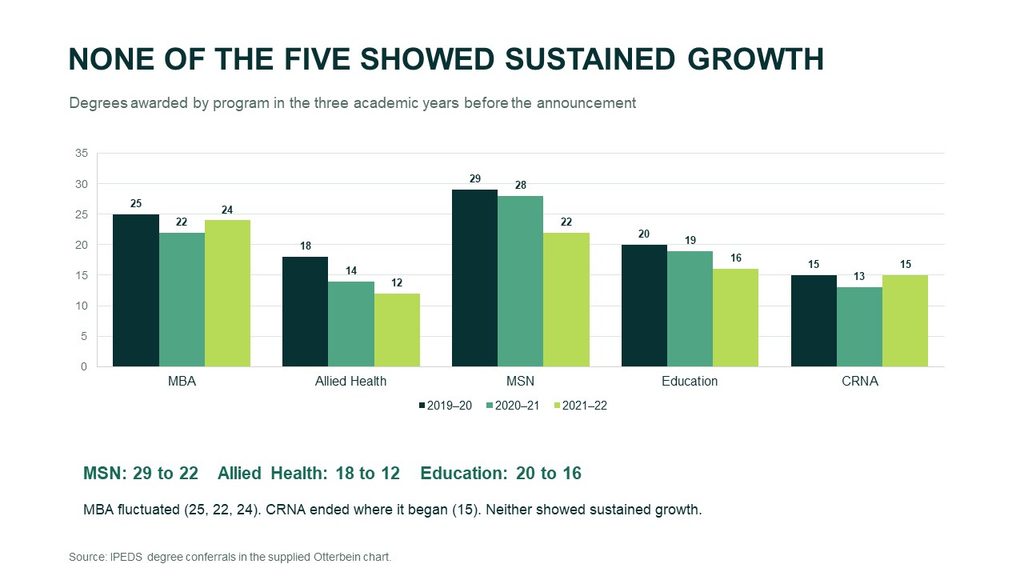
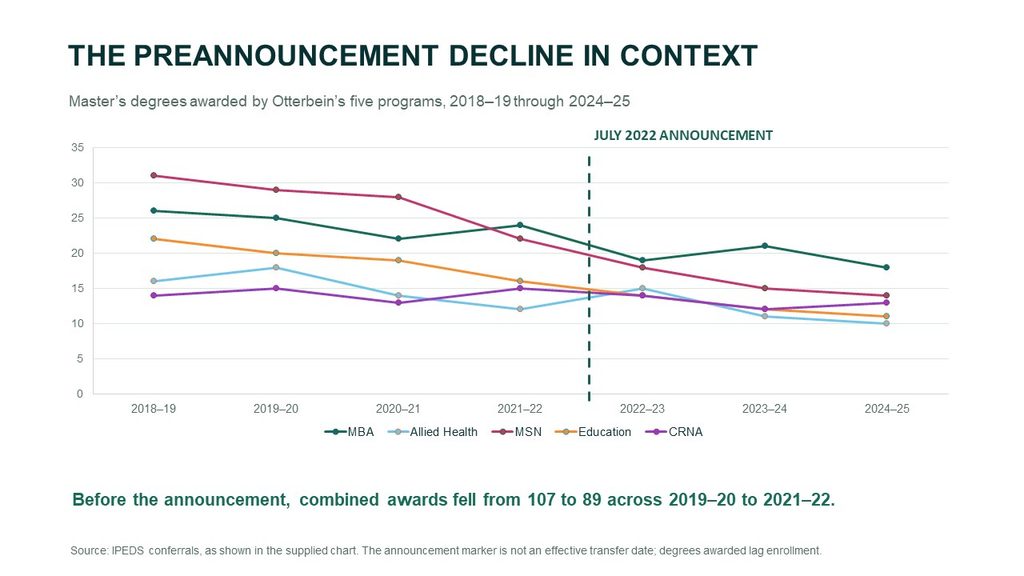
Otterbein Pitched Growth. Its Programs Were Already Shrinking.
ANTIOCH INHERITED A TURNAROUND, NOT A LAUNCH.
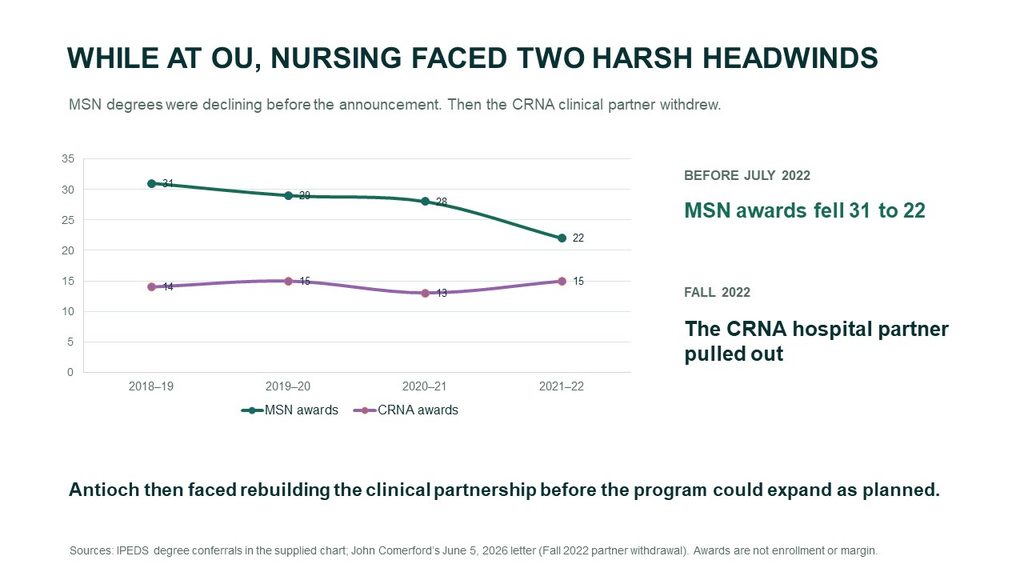
Key Data that Describe Otterbein’s Transferred Programs. OU’s “Ready to Scale” narrative doesn't fit.
Cover headline above is an editorial characterization supported by the supplied Otterbein/IPEDS preannouncement degree conferrals chart and President Comerford’s June 5, 2026 letter confirming that Grant Hospital pulled out of the CRNA program in fall 2022. It does not establish the profitability of the programs, a dollar cost of rebuilding, or causation of subsequent enrollment declines.
DOWNLOAD THE SLIDES → PowerPoint
DOWNLOAD THE SLIDES → PDF